ON MOTHS
Moths, calmly
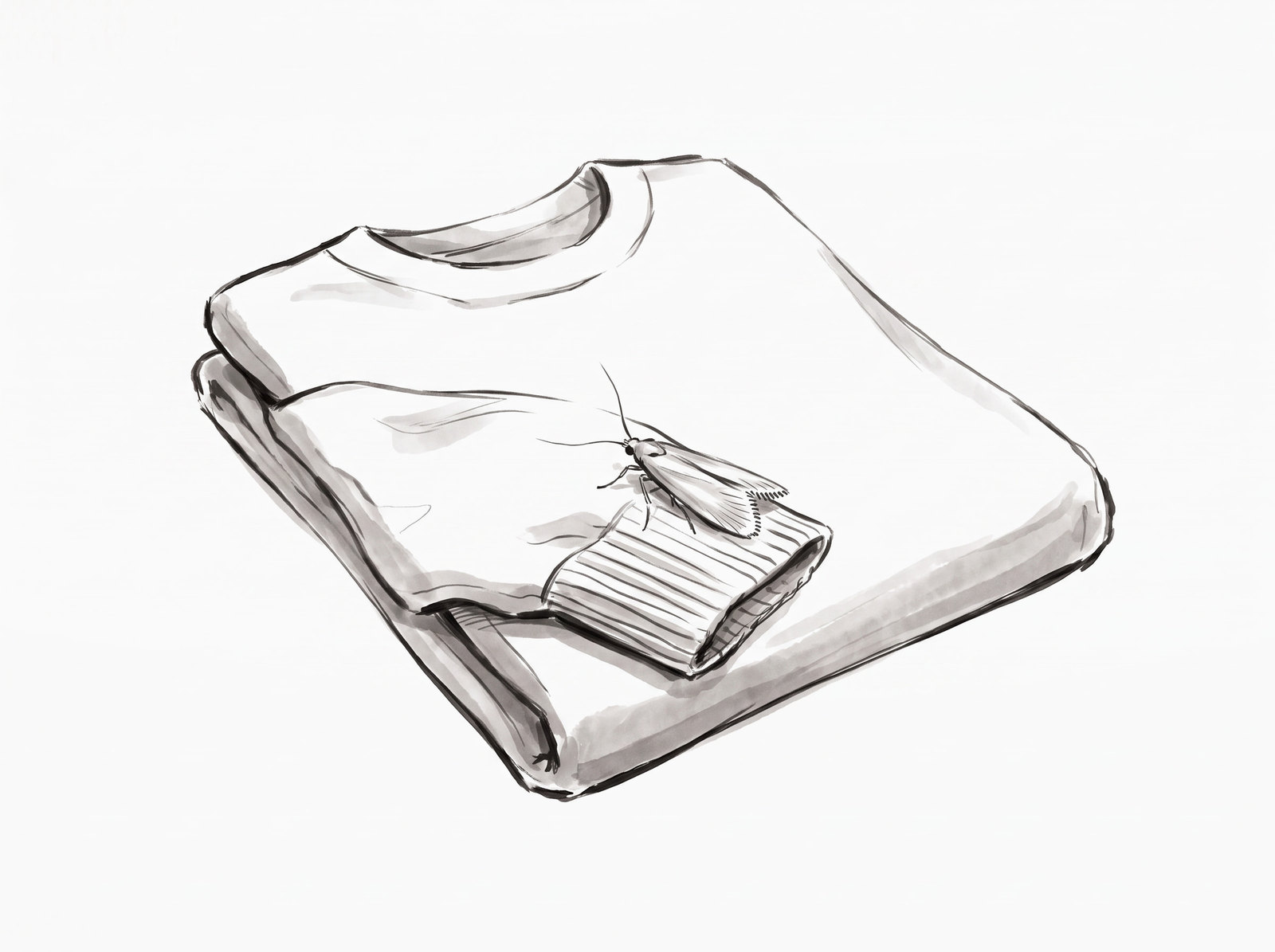
There is a particular feeling that comes with finding the first hole. It is usually in something you love, because the things you love tend to be wool and cashmere, and it is usually small, and the feeling is out of all proportion to its size. Within the hour there is a search history full of infestations and a basket full of sprays.
Most of that is unnecessary. The clothes moth is a small, shy, predictable creature with very definite tastes, and nearly everything that keeps it out of a wardrobe is ordinary housekeeping. It helps to begin by knowing what it is.
In British homes the damage is almost always done by one of two species. The more common is the webbing clothes moth, a small insect, about a centimetre long, with shiny pale-gold wings and a tuft of gingery hair on its head. The other is the case-bearing clothes moth, silvery grey, with faint dark spots on its wings. Unlike the moths that batter at a lit window on a summer night, both avoid the light.
The adults do no harm to clothes at all; they do not eat. The damage is done by their larvae, which hatch from eggs laid on the cloth and feed on keratin, the protein in wool, cashmere, silk, fur and feathers. They have clear preferences. They want dark, undisturbed places: the inside of a fold, the underside of a collar, the back of a drawer that is never opened, the edge of a carpet under a bed. And they go first for fabric that has been worn and not washed, where there are traces of sweat, food and skin. English Heritage, which has spent years counting moths in historic houses, finds that a stained patch of a textile can be eaten while the clean cloth beside it is left alone.
So the moth is not a mystery. It wants wool, dirt, darkness and peace. You will not give up the wool, but take away the other three and it has very little to work with.
How worried should you be? Less than the newspapers suggest. In 2017 English Heritage reported that the numbers of webbing clothes moths at its sites had doubled in five years, and the story ran everywhere, as stories about moths do. The National Trust has since reported numbers falling at its houses in 2022 and 2023, after a rise during the pandemic, when those houses stood closed and undisturbed. That last detail is the whole lesson in miniature. Moths did well in rooms that nobody was walking through.
Prevention, then, is four habits.
Keep things clean. Anything wool or silk that is going to sit unworn for a while, in a drawer for a month or a box for a season, should go in washed or cleaned.
Disturb them. Moths lay their eggs where nothing moves. A wardrobe that is opened every day, and a drawer that is emptied and refolded now and then, are poor places to raise a family; English Heritage suggests shaking out stored clothes once a month. The larger part of the job is done by the vacuum cleaner. The same guidance holds that regular vacuuming does more than anything else to stop moths building up, with the crevice tool along the edges of carpets, under furniture and into the corners of wardrobes, where fluff and fibre gather and larvae feed unseen.
Keep them closed. Clean wool put away for a season is safest in a sealed bag or a box with a close-fitting lid, which a moth cannot get into.
And keep an eye out. Irregular holes, fine silken webbing or tubes in the fold of a garment, small gritty droppings, or, from the case-bearing moth, little empty cases stuck to a surface: these are the signs. Neat holes with no webbing, and small hairy larvae or their shed skins, point instead to carpet beetles, the larvae known as woolly bears, whose adults you may find on a windowsill. The prevention is the same.
What about cedar and lavender? They are the traditional answer, and the honest verdict on both is that they are pleasant, and weak.
Cedar oil can kill very young larvae, but only at a concentration that a wardrobe or a chest cannot hold, since neither is airtight, and its strength fades as the oil evaporates over the years. Lavender sachets and cedar balls repel adult moths for a few months at most, and English Heritage is clear that they have no effect on larvae already in the clothes. Use them if you like the smell. Don’t rely on them.
Pheromone traps are useful, but not in the way their packaging may imply. The lure attracts only male moths, so a trap will never clear an infestation. What it does well is tell you whether you have moths and where they are coming from. A few catches near the bedroom wardrobe and none elsewhere is information. So is a trap that stays empty all year.
If you do find them, the first thing is not to panic, and the second is to find the source. A hole in one jumper does not mean an infested house. Take everything out of the drawer or wardrobe where the damage was, look at each piece in good light, especially at the folds, collars and cuffs, and set aside anything with holes, webbing or larvae. Vacuum the empty space thoroughly, and empty the vacuum cleaner outside.
The affected pieces then need treating, and here the answer depends on the fibre.
Heat kills every stage of the moth, but only at around fifty degrees held for half an hour, far hotter than most wool or cashmere will survive, which is why the pest controllers’ own association does not recommend hot washing for woollens. For anything whose label allows that heat, a hot wash works.
Cold is the method conservators use, and it is gentle on cloth. English Heritage’s guidance is to wrap the item in tissue, seal it in a polythene bag with the air pressed out, and freeze it at minus eighteen to minus twenty degrees for two weeks. Most home freezers run at about minus eighteen, which is enough if you give it the full fortnight, though English Heritage advises against freezers that defrost themselves, because they warm up as they do it. Leave the bag sealed at room temperature for at least a day afterwards, so that condensation forms on the plastic rather than in the cloth. Then brush the garment well, out of doors, to clear away whatever died in it, and keep an eye on it for a few weeks. Older advice said to freeze everything twice; more recent conservation guidance holds that one cycle, cold enough and long enough, is sufficient.
Dry cleaning is where the sources genuinely disagree. Some entomologists count it as a treatment. The pest controllers’ association does not, because cleaning solvents are not insecticides, and a garment carrying live larvae can carry them to the cleaner’s.
If you are finding moths in more than one room, or in the carpets, or they come back after all this, it is time for a professional. Be wary of the old chemical remedies: the mothballs of a generation ago are now banned or advised against, and any insecticide you do use should be one approved for use in the UK, used exactly as its label says.
Most of the time it will not come to that. A wardrobe of clean clothes, opened every day, vacuumed into its corners and closed at night, is a poor place for a moth. Moths are not an invasion. They are a symptom of stillness, and the cure for stillness is simply to wear what you own.