ON STORAGE
The box you will open in May
In August this Journal argued that the changeover is where you read the result of a season: the few garments that look used, and the many that come out of the drawer exactly as they went in. That is the reading. This is the other half, the packing, which is less philosophical and matters as much, because a box of clothes put away in October is the only time in the year that anything you own is left completely alone for six months. Whatever you put into it goes on happening, unwatched, until May.
Most of what goes wrong in storage was already in the box on the day it was closed.
The first rule, then, and the one everything else depends on: nothing goes away dirty.
It is tempting to box a summer dress worn once since it was washed, on the grounds that it looks clean. It probably does. The trouble is what cannot be seen. A splash of white wine or fruit juice on a linen shirt is often invisible on the day it goes away. Over the months in storage the sugars in it slowly oxidise into the brown mark that appears, apparently from nowhere, when the box is opened. By then it has had half a year to set.
And insects are drawn to exactly the same traces. The larvae of clothes moths and carpet beetles go for fabric soiled with food, drink, perspiration and the oils of skin and hair, and where there is enough of it they will eat even cotton, which clean they leave alone. A box of worn and unwashed clothes, closed and left in the dark, is as close as a house comes to laying a table for them.
So wash or clean everything that is going away, even the things that look fine, and let it dry completely, for a day longer than you think it needs, before it goes in. Damp packed in October is mould by spring.
Then the box itself.
The dry cleaner’s plastic, and thin plastic bags in general, are the wrong thing to keep clothes in for months. A bag holds whatever moisture is inside it, and when the temperature falls the air in the bag grows damper still. Conservators advise against it and prefer cotton: a cotton bag for anything that hangs, and for folded things, a box.
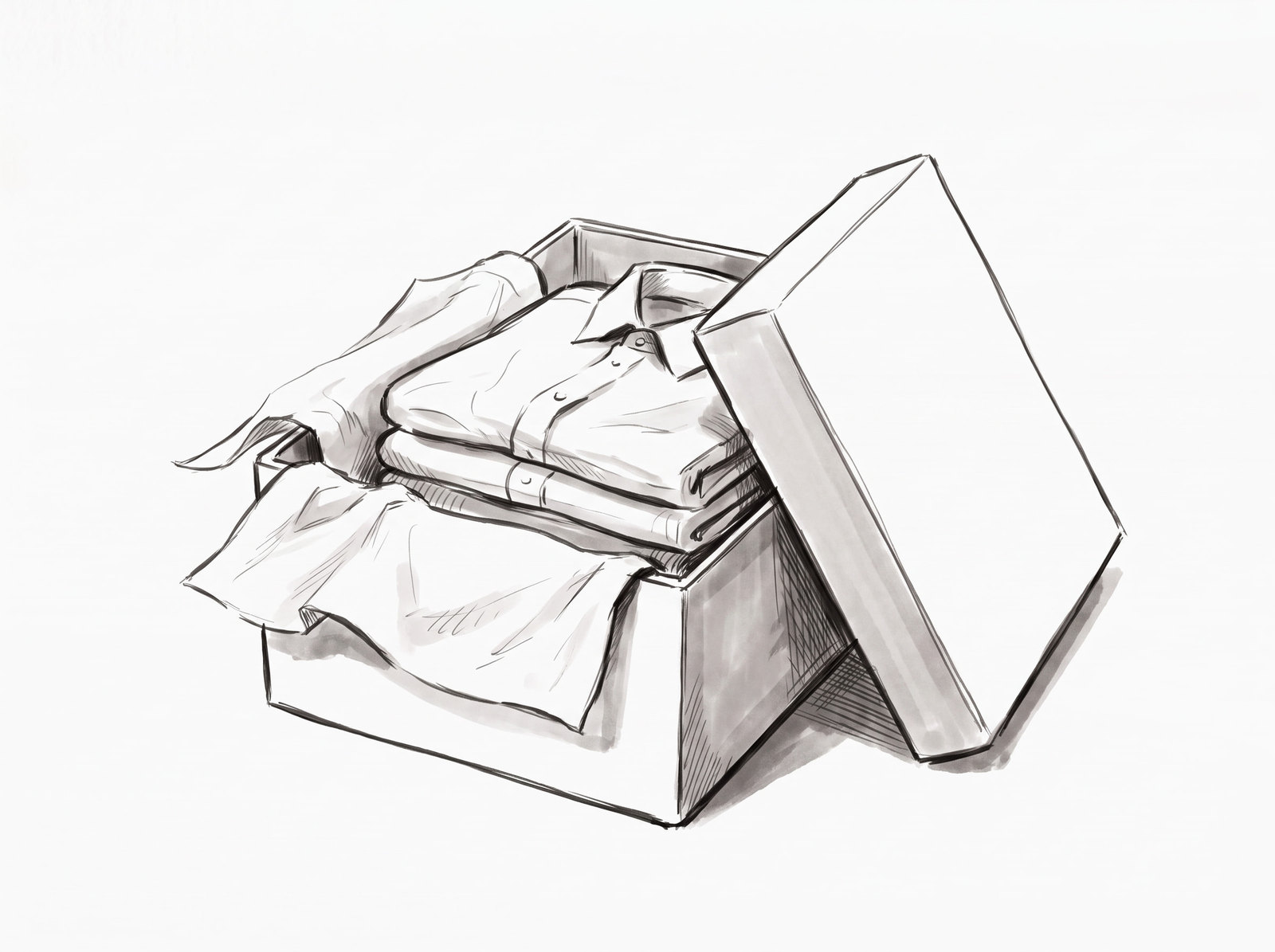
Which box is a question on which careful people disagree less than it first appears. Museums that keep textiles use acid-free card boxes, and also boxes of polypropylene or polyethylene, the stable plastics most lidded storage boxes are made from, which give off nothing harmful. The distinction that matters is between a thin bag clinging to the cloth, which holds damp against it, and a rigid box with room inside, holding things that went in clean and dry. The second is fine, and a lid that fits well keeps moths out.
Line the box with acid-free tissue, and put crumpled tissue into the folds so that the cloth bends over a soft curve rather than a sharp edge. For silk and wool, choose the unbuffered kind. And fold as little as you can. A fold held under weight for months is where fibres eventually break, which is why conservators refold stored textiles along new lines from time to time; anything that will be boxed for more than a season deserves the same. Put the heaviest things at the bottom and the most delicate on top, and never press a lid down on a box that is too full.
Vacuum bags deserve a paragraph of their own, because the advice about them contradicts itself.
The case for them is real. While the seal holds, a moth cannot get in, and English Heritage, which has studied clothes moths in its houses for years, recommends sealed bags, vacuum ones included, for keeping woollens safe. They also save a great deal of space.
The case against is less well established than its confidence suggests. The claim that months of compression damages wool comes from retailers, not from research; I can find no conservation body that has studied it. What is agreed is more modest. The seal does not always last, and a bag that has quietly let air back in is protecting nothing. Anything packed in one must go in bone dry, because a sealed bag will hold damp against the cloth all winter. Compressed clothes come out creased, and need time or steam to recover. And the makers of down and insulated clothing say plainly that their garments should be stored uncompressed, because the warmth depends on the loft.
Leather should never go into one, or into any sealed plastic. Leather holds moisture, and shut in with it, it grows mould.
A reasonable way through is vacuum bags for clean, dry knitwear where space or moths are a real worry, looked at now and then to see that the seal has held, and boxes or cotton for everything else.
Then where the box goes.
The loft and the cellar are the two places a house offers most readily, and the two places conservators most often tell you to avoid. A loft is hot in summer and cold in winter, a cellar is often damp, and it is the swings of temperature and humidity, as much as either extreme, that do the harm. Heat in particular speeds up the slow chemistry by which cloth ages. The rule of thumb in conservation is that every five degrees warmer roughly doubles the rate. The advice is to keep clothes where you live: a bedroom, a cupboard on an inside wall, the space under a bed. Somewhere cool, dark, dry and steady.
Lavender bags and cedar balls tucked among the clothes are pleasant, and do less than they promise. They repel adult moths for a few months at most, and do nothing to larvae already in the cloth. Clean clothes and a closed box do far more.
What stays out is whatever you would genuinely wear in any month: the dark trousers, the good shirt, the light wool that goes under a coat in March and on its own in June. In Atelier every piece carries the seasons you would wear it in, which makes the packing list for you. What is marked for summer alone goes into the box; what is marked for every season stays out.
And while each piece is in your hands, it is worth asking August’s question once more. Did I wear this? A box is a strange place to keep something that has already sat out a season untouched, and it will seem stranger still in May.
Tape it shut, write the season on the side, and put it somewhere cool. Done well, the box will be the least interesting thing in the house until spring, and when you open it, everything in it will be exactly as you left it. That is all a box is for.