ON KNITWEAR
A jumper is not made to hang
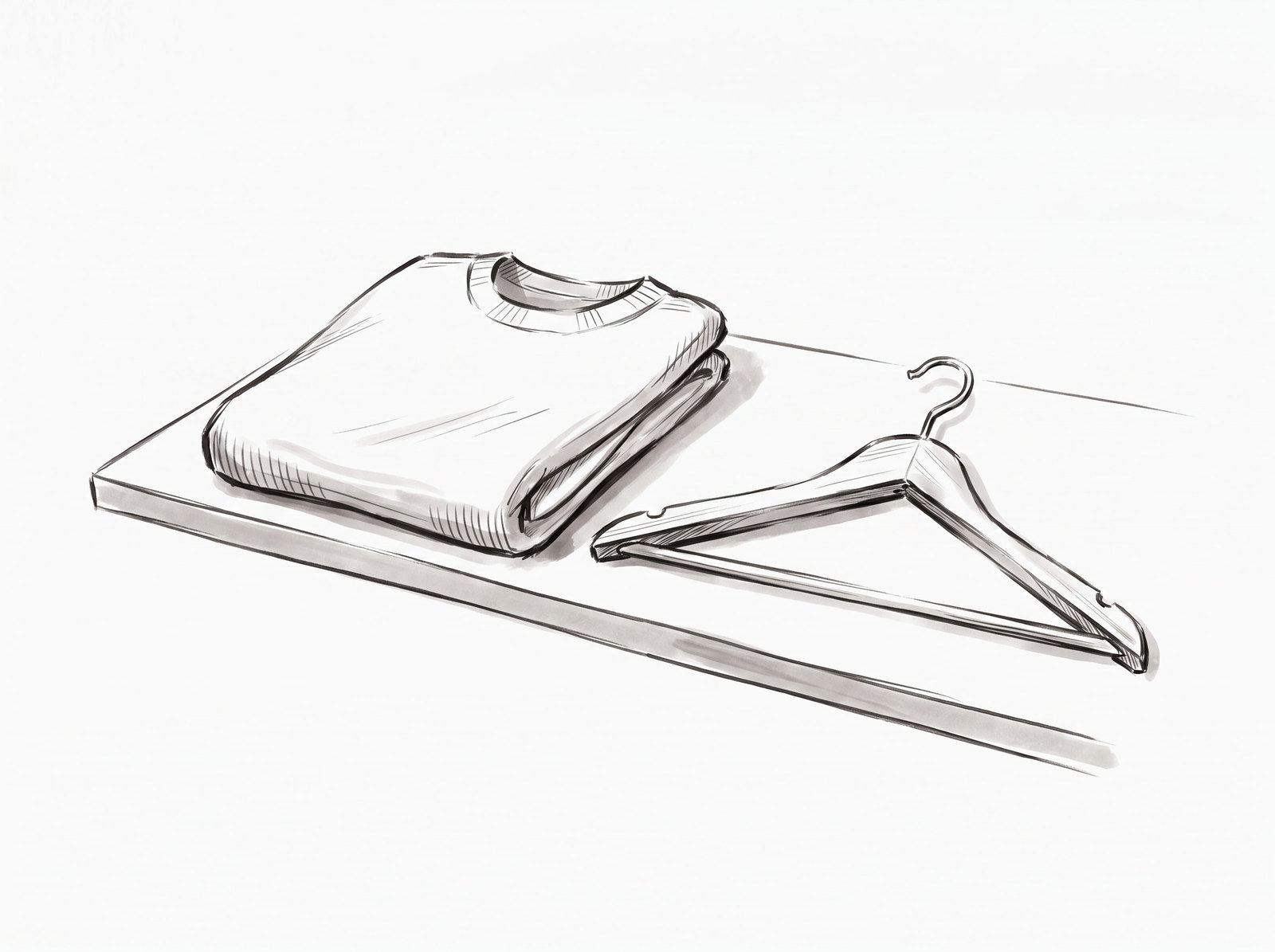
Every autumn the jumpers come back, and every autumn a few of them come back changed. One is longer than it was in March. One has sleeves that now reach the knuckles. One has a small peak standing up at each shoulder, where the ends of a hanger pressed in all summer. None of this happened while they were being worn. It happened while they were being kept.
The reason is structural, and worth understanding, because once you see it the rest of the advice follows on its own.
A woven cloth, the kind a shirt or a pair of trousers is made from, is a grid: threads running one way, threads crossing them the other, each holding the others in place. Pull it along the grain and it barely moves. A knit is something else. It is a single yarn drawn through itself in rows of loops, and a loop is built to give. That is the whole pleasure of a jumper, the way it follows you when you reach and settles when you stop. It is also its weakness. Textile conservators say that knits lack dimensional stability, which is a precise way of saying that a knit has no fixed shape of its own. It takes the shape it is held in.
Hang one, then, and you have asked it to hold the shape of a hanger, with the whole weight of the garment pulling down from two points at the shoulders. A heavy knit gives faster than a fine one, and a wet one fastest of all, but they all give. The loops at the top open a little. The body lengthens. The sleeves, which hang furthest from any support, drop. It is slow enough that you never see it happen, and lasting enough that you notice it in October.
So the rule, which the makers of fine knitwear and the bodies that look after wool give in almost the same words, is to fold it and lay it down.
You will sometimes see a compromise recommended, in which the jumper is folded lengthways and draped over the bar of a hanger, so that nothing pulls at the shoulders. It is kinder than hanging from the shoulders. But it is not what the people who make knitwear, or look after wool, advise. They say fold. A drawer or a shelf lets the whole garment lie at rest, its weight spread evenly and carried by the wood beneath it rather than by its own loops.
Folding is quick once you know the shape. Lay the jumper face down, bring each sleeve back along the side seam so that the fold falls where the garment already has an edge, and fold the body in half or in thirds, whichever suits the depth of the drawer. Folding along the seams, rather than across the middle of a panel, keeps the creases where no one will see them. And a crease in a wool knit tends to relax with wear, which a stretched shoulder does not.
Give the drawer room. A stack of eight jumpers is a stack in which the bottom three are pressed flat by the other five and never chosen, because reaching for them means lifting everything else. Two or three high is plenty, with the heavier knits underneath and the finest on top, where nothing presses on them. Somewhere cool, and out of the sun, is better still. A shelf that catches the afternoon light will slowly fade the side of whatever faces it, and that damage does not reverse.
The second thing most of us do to knitwear, after hanging it, is wash it too often.
Wool does not need washing after every wear, or after most. The fibre is springy by nature, and given a day off it recovers much of its shape by itself; the wool industry’s own guidance is to rest a wool garment for twenty-four hours between wearings for exactly this reason. The same guidance says that a knit which smells of a restaurant or a bonfire will lose it if you lay it flat somewhere airy for an hour. The industry also reports, from its own research, that wool holds on to body odour less than cotton or polyester. That is a trade body describing its own product, so take it as a claim rather than a law, but it matches what most people who wear wool find: a jumper worn over a shirt can go many wearings between washes, and airing does most of what washing would.
When it does need washing, as a jumper worn against the skin eventually will, the thing to avoid is felting. Each wool fibre is covered in fine overlapping scales, a little like the tiles of a roof. Warmth and water lift them, and movement then works the fibres against one another until the scales catch and lock, and the knit shrinks and thickens into something closer to felt. It cannot be undone. Heat, water and agitation together are the whole recipe, and a hot wash or a vigorous rub supplies all three.
So wash cool, and follow the label, which has the last word. By hand, that means lukewarm water, no warmer than about thirty degrees; by machine, only on a wool cycle, and only if the label allows it. Use a detergent made for wool. Ordinary biological detergents contain enzymes designed to break down protein stains; wool is itself a protein, and the wool bodies tell you to keep such detergents away from it. Bleach is out altogether. Let the jumper soak rather than scrubbing it. Then press the water out, never wring or twist it, and lay it flat on a towel to dry, eased back into shape with your hands, away from the radiator and out of direct sun. It will take a day, perhaps two. A jumper hung up full of water is the quickest way there is to make one longer.
If you keep your wardrobe in Atelier, the care reminder on a wool or cashmere piece counts the wears since you last cared for it, not the weeks, which is the right way round. A jumper does not need attention because a month has passed. It needs attention because it has been worn.
Then there is pilling, which worries people more than it should.
The small balls of fibre that gather at the elbows, under the arms, and along the sides where an arm brushes as you walk are made by friction: loose fibres at the surface work free and tangle together. Yarns made from shorter fibres, or spun loosely for softness, pill more readily than long, tightly twisted ones. The cashmere makers are at pains to say that pilling on a new jumper is not a sign of poor quality, only of loose fibres working their way out. They have an interest in saying so, but it is consistent with how pilling works.
The remedy is simple and unhurried. Lay the jumper flat and draw a cashmere comb, or a fabric shaver, lightly across the surface in one direction, and the pills lift away. Do it when you notice them rather than letting them build, and do it gently: you are clearing loose fibre from the surface, not cutting into the knit.
There is one more reason to put knitwear away clean and folded, rather than worn, hung and forgotten. The larvae of the clothes moth eat wool, and conservators have found that they go first for cloth that has been worn and not washed, where there are traces of sweat, skin and food. A clean jumper in a drawer that is opened often is the plainest protection there is. Moths deserve an essay of their own.
Fold it, rest it, air it, and wash it seldom and cool. That is very nearly the whole of it. The jumper that comes back in October exactly as it went away in March is not a lucky one. It is one that spent the summer lying down.