ON ENDURANCE
On the seven-year wardrobe
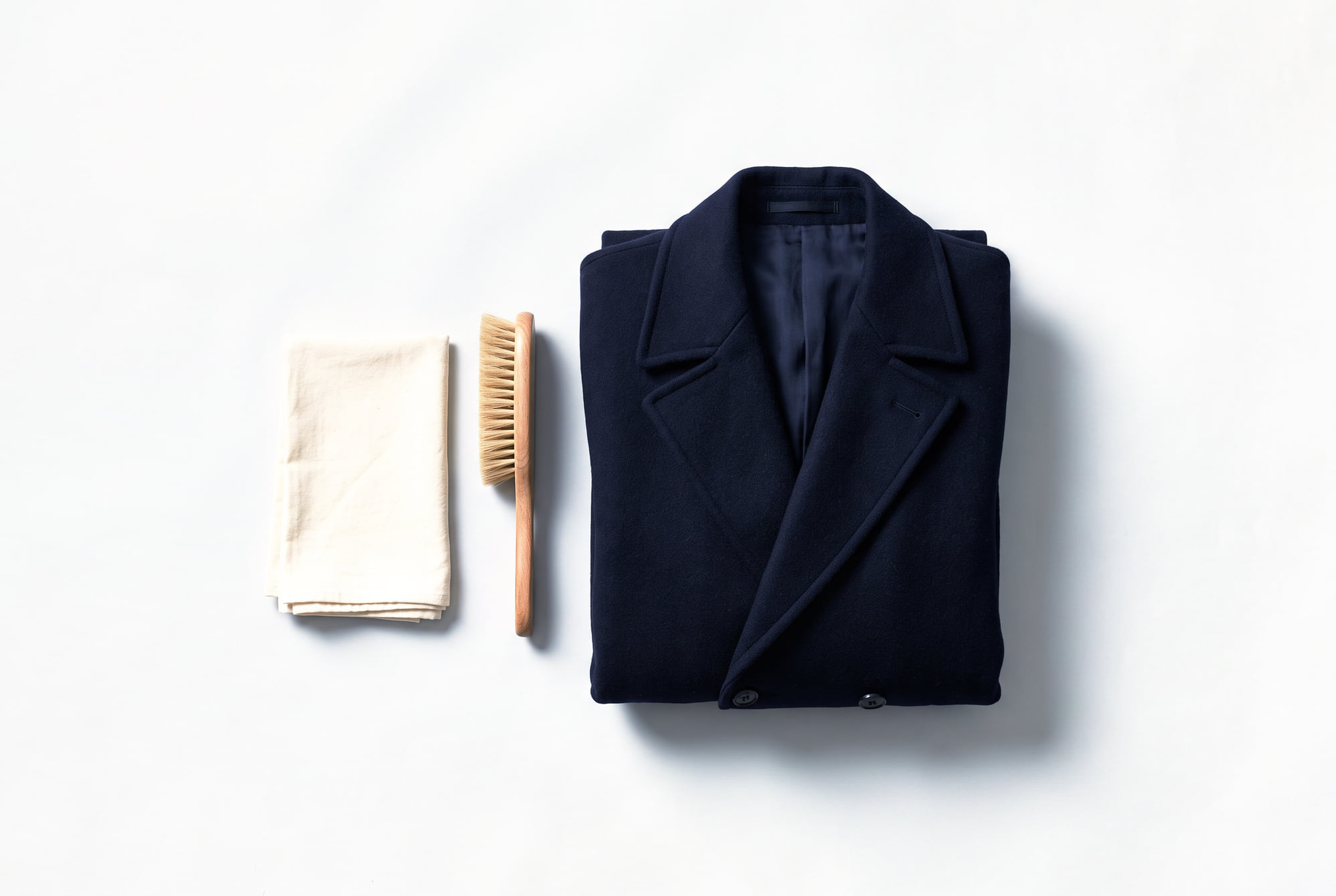
A certain kind of garment survives. It is not, usually, the most beautiful piece you have ever owned. It is not the one you wore to the wedding, or the one that announced something about you in your twenties, or the one a particular person used to tell you they liked. More often it is a plain dark jumper. A pair of trousers cut the right way. A coat you bought when you were paid a little too much for the first time. It has lasted you seven years.
Seven is a useful number. Long enough for the trend that animated the wardrobe to cycle through and start coming back the other way. Long enough for the body to have changed at least once. Long enough for the city, the job, possibly the relationship, possibly even the version of the self that did the buying, to be different. A garment that has survived all of that is no longer simply a garment. It is a piece of evidence.
This essay is concerned with that evidence: what it consists of, what its survivors have in common, and what it costs to accumulate.
The first thing to notice about a seven-year garment is that you almost never set out to acquire one. The intention behind most purchases, even the considered ones, is shorter. You bought the jumper for the winter. You bought the coat for the season. You bought the trousers for a particular meeting, or a particular kind of weather, or a self-image you were trying on at the time. The seven-year-ness of a garment is something it grows into, not something you bestow on it at the cash desk.
This is humbling. It means that no amount of careful thinking at the moment of purchase can guarantee that the thing you are buying will become important. You can make educated guesses about quality. You can examine the seams, the weight of the cloth, the cut. You can buy from someone whose name you trust, in a fabric you understand. These improve the odds. They do not make the decision for you. The wardrobe, ultimately, is the judge, and it issues its verdict slowly, garment by garment, year by year.
What this means in practice is that stewardship is not principally an act of selection. It is principally an act of attention sustained over time.
If you sort, after seven years, the pieces that have survived from the pieces that have left, certain patterns emerge.
The survivors are rarely the most expensive items. They are often middle-priced. The most expensive thing in any wardrobe, the investment piece or the splurge, is statistically less likely to last than the workhorse acquired without ceremony. This is not because expense is bad. It is because expense is often tied to occasion, and occasion-wear has a short half-life.
The survivors are almost always neutral in some axis. Not necessarily neutral in colour (a survivor can be a deep brick red), but neutral in fashion-orientation. They are not the dress of the moment. They are the dress that could have been made twenty years ago, or twenty years from now. They sit outside the cycle they were nominally purchased within.
The survivors are also, almost always, things that fit well at the body’s resting state, not its aspirational one. The jumper bought for the body you might have at the end of a diet does not survive the diet’s failure. The trousers bought for the body you had at twenty-eight do not survive your thirties. The pieces that last are the ones that knew the body they were dressing.
Then there is the variable that is least romantic but most decisive: the survivors are always things that can be cared for. A wool jumper that can be hand-washed and reshaped survives; a cashmere one that pills beyond repair and cannot be safely cleaned does not. A leather boot that can be resoled survives; a synthetic sneaker that delaminates after the second winter does not. Stewardship requires materials and construction that permit it.
This last point is the contemporary problem.
A great deal of clothing on the market today cannot be cared for in any meaningful sense. The seams are glued rather than sewn. The fabrics are blends designed for low cost rather than long service. The finishings (buttons, zippers, linings) are made to a price point that assumes the garment will not be repaired, because it will not be in the wardrobe long enough to need repair.
This is not an indictment of any particular brand. It is the structural fact of a market that has decoupled the price of clothing from the cost of producing it well. The seven-year wardrobe is a niche pursuit not because seven-year garments are rare in spirit, but because seven-year garments are, increasingly, rare in stock.
Building toward endurance, under these conditions, is itself a quiet act of resistance. It involves buying less, buying better, paying more per garment and less per year of garment, and, above all, making the maintenance of what you own part of the practice. The brush. The sewing kit. The relationship with a local cobbler and a local tailor. The willingness to mend a small hole rather than treat it as the end of the piece.
This is what stewardship looks like in practical terms. It is not a romantic posture. It is a set of small repeated actions, performed over years, with a particular orientation toward the future.
It helps, perhaps unexpectedly, to keep the time horizon visible.
The strange thing about a seven-year wardrobe is that while you are inside it, the seven years are invisible. You are simply getting dressed. The third year of the coat looks identical to the first. The jumper does not announce its anniversary. The trousers are, this morning, just trousers.
The horizon only becomes visible if it is measured. And measurement, by which I mean keeping track of what you wear, when, and how often, is the missing piece of most domestic clothing practices. Almost no one knows, off the top of their head, how often they have worn the coat they bought three winters ago. The estimate, when asked for, is usually wrong by half.
This is where a private record becomes useful. Not for vanity, not for analytics, but because a record turns the seven-year horizon from a vague aspiration into a visible quantity. A garment with a wear log accumulates evidence of its own value: thirty wearings, sixty, two hundred. A jumper at two hundred wearings is, by any honest accounting, an extraordinary success. A dress at four wearings, three years in, is asking a question the wardrobe-keeper would do well to answer.
In Atelier, every item carries a small wear log and an updating cost-per-wear figure. These are not the point of the practice; they are the visibility of the practice. They make the long horizon legible while you are still inside it, so that you can see, before the garment leaves you, whether it is on the path toward being a survivor or on the path toward being a polite regret.
The seven-year wardrobe is not a wardrobe of seven things. It is not a capsule, although it can contain one. It is not minimalist, although it tends toward restraint over time. It is simply a wardrobe whose pieces are loved enough, used enough, maintained enough, noticed enough, to last that long.
It is also a wardrobe that, over the long arc, makes the morning easier. The thing you reach for at seven a.m. is not a thing that requires a decision; it is a thing whose membership in your life has been earned. The argument with the closet is over. The pieces that are there are the pieces that should be there.
There is, in the end, no luxury more durable than this.